AI Will Replace Human Workers — But Probably Not the Way You Think

AI Will Replace Human Workers — But Probably Not the Way You Think
There’s a widespread assumption about how AI will displace human workers: it starts at the bottom and works its way up. First to go will be assistants, secretaries, analysts, accountants, graphic designers, developers. The entry-level roles. Then, gradually, everyone else.
I think that’s wrong — and the companies that buy into it are going to lose.
The businesses that actually win will be the ones that deploy AI from the top down.
I. Accountability without oversight is a mess
Here’s the fundamental problem with replacing low-level workers first: someone still has to be responsible for the output.
In any organization, processes need owners. If you swap out your entire junior workforce for AI agents overnight, all that accountability rolls uphill to managers. Suddenly their scope explodes. And here’s the catch — efficient AI will produce work faster than any human can review it. Your manager is then stuck with an impossible choice: rubber-stamp everything the AI generates (in which case, why have a manager at all?) or personally verify every output (in which case, the AI actually slows things down compared to before).
Human oversight of AI workers doesn’t scale. It’s a structural dead end.
II. If AI is smarter, why is it reporting to you?
Assume for a second that AI has already surpassed human-level performance on most knowledge work — which is increasingly close to true. If that’s the case, putting a less capable human above a more capable AI doesn’t just waste potential, it actively creates drag.
A company with human managers supervising AI workers will lose to a company with AI managers supervising human workers. Full stop.
AI is already demonstrably better at analyzing data, identifying patterns, and managing resources than humans are. These are exactly the skills you need in leadership — strategy, planning, optimization, coordination. The tasks where AI still struggles (intuition, interpersonal judgment, reading a room) are far more relevant at lower levels of an organization than at the top. Leadership is where AI’s strengths are most useful.
III. Start at the top — and here’s why it works
Replacing the CEO, directors, and managers first isn’t just a philosophical preference. It’s the only approach that makes operational sense.
An AI in a leadership role has visibility into the entire company — its goals, its bottlenecks, its competitive position. From that vantage point, it can actually study the human workforce beneath it: what’s working, what’s redundant, where the real leverage is. It learns the organization from the inside out before making any decisions about restructuring it.
Now imagine the alternative: human executives picking AI tools to slot into junior roles they barely understand. Most C-suite leaders have a 30,000-foot view of the company. They don’t know what actually happens at the operational level day-to-day. Asking them to specify, procure, and deploy AI workers for roles they’ve never done is a recipe for failure.
Any company that goes bottom-up will get wiped out by one that goes top-down.
IV. How the rollout actually plays out
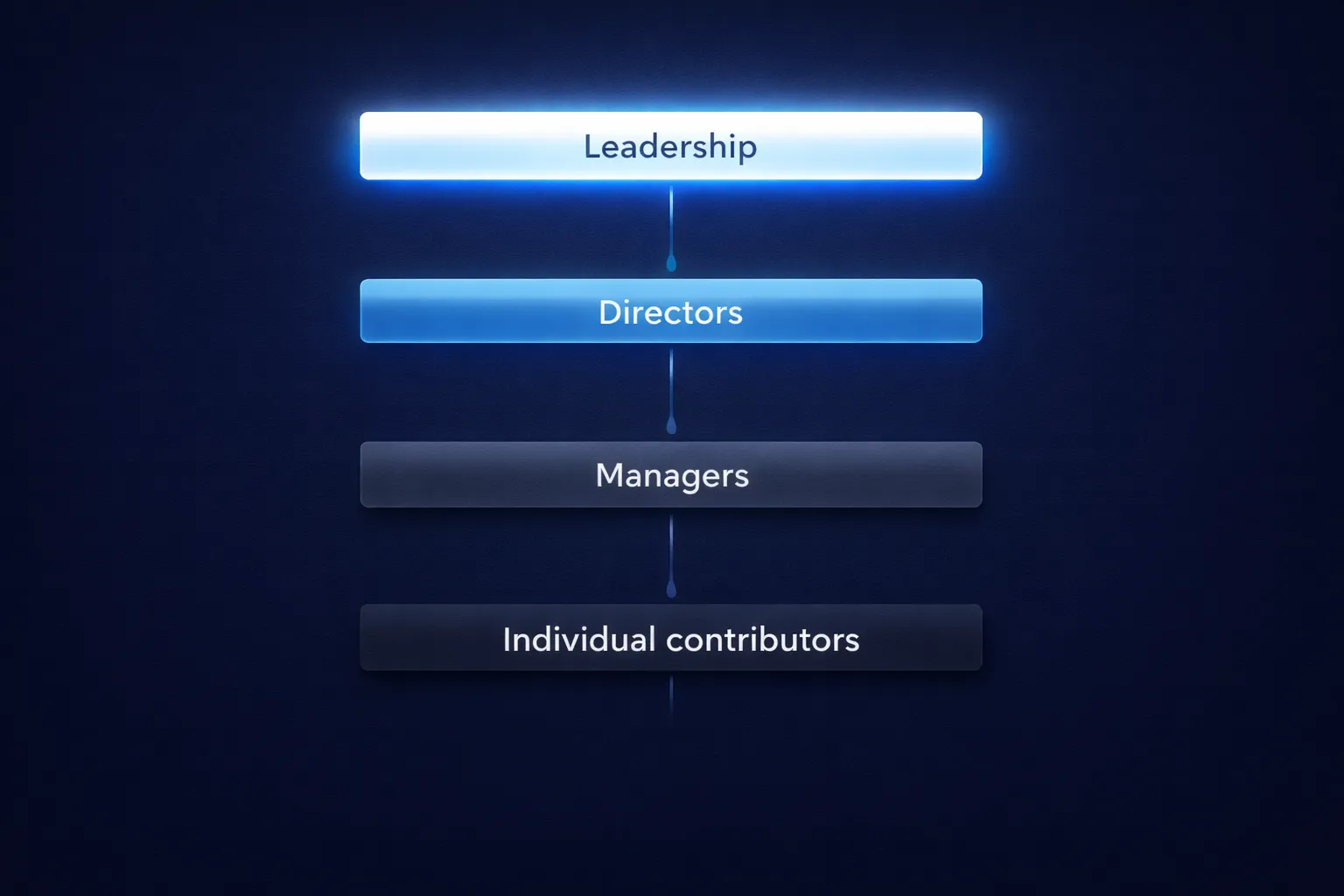
In a properly sequenced AI transition, you start with the C-suite — CEO, CFO, COO — then directors, then middle management. At each stage, the AI leadership builds a deeper, more granular picture of how the company actually functions.
By the time it reaches operational roles, it knows exactly what’s needed. It can identify which positions are underperforming, which are redundant, and which ones are worth investing in. It can draft precise, detailed specs for the AI agents that will eventually fill those roles — whether that’s a customer service rep, a graphic designer, or a software engineer. Not a generic hire. A tailor-made one.
This is the right sequence:
Leadership → Directors → Managers → Individual contributors
Conclusion
The companies that survive the AI transition will be the ones willing to make the uncomfortable call first — replacing leadership before replacing labor. The ones that go the other way will struggle with bloated, misaligned hierarchies that slow everything down.
A lot of legacy corporations may not make it through this. Their place will be taken by startups that never had the organizational baggage in the first place and aren’t afraid to build with AI at the helm from day one.
And once we reach AGI — and certainly after ASI — this all becomes moot anyway. The era of human labor ends. Whether what comes after that includes human relevance at all is a different question entirely.